
2026-11-14
2026 China Automotive Parts Die Casting Guide: Cost, Tolerance & OEM Supply


📋 Guide Overview
This page covers core definitions, quality standards, sourcing steps, cost structure and use cases for China-based automotive die casting, with insights directly from 18 years of client service experience at Ningbo Tianye Precision Casting, a leading supplier to global EV, ICE and commercial vehicle brands.
What Is China Automotive Parts Die Casting?
chinaautomotivepartsdiecasting refers to the high-pressure injection of molten non-ferrous alloys into precision steel molds to manufacture production-grade automotive components, primarily operated by specialized manufacturing facilities across China’s industrial hubs. This process accounts for more than 60% of global non-structural automotive metal component output, per 2026 industry data, due to its ability to deliver complex, consistent geometries at scale with minimal post-processing. In practice, this manufacturing model allows global automotive brands to balance production cost efficiency, quality consistency and supply chain resilience, compared to equivalent domestic production in Europe, North America or Japan.
Core Competitive Advantages of China-Based Die Casting Suppliers
From our 18 years of serving North American and European EV and ICE clients, the biggest benefits include 25-40% lower total part cost compared to in-house die casting in North America, integrated supply chains for secondary operations (CNC machining, powder coating, plating) that reduce lead times, and access to engineers with deep experience optimizing part design for high-volume production. Industry consensus is that China’s Yangtze River Delta region, where Ningbo Tianye is based, hosts the highest density of precision die casting facilities with IATF 16949 certification for automotive use.
Typical Automotive Parts Produced via This Process
Actual production data from our facility shows we currently manufacture 12+ categories of die cast automotive parts, including transmission housings, EV motor end shields, brake caliper components, steering system brackets, engine mounting brackets, sensor housings, battery tray structural brackets and charging port components. Our lines produce 2.3 million parts annually, with a 98.7% first-pass quality yield across all client orders.
Key Quality Standards for China Automotive Parts Die Casting
All qualified China automotive parts die casting suppliers must adhere to mandatory IATF 16949 automotive quality management standards, in addition to material-specific industry requirements for safety-critical components. Sourcing from uncertified suppliers exposes buyers to 3x higher risk of batch quality deviations, per 2026 global supply chain risk data.
Mandatory Certification Requirements for Automotive Die Casting Suppliers
To qualify for production of road-legal automotive parts, suppliers must hold valid IATF 16949 certification, maintain full material traceability for every production batch, and operate in-house testing capabilities including coordinate measuring machines (CMM), optical emission spectrometers for material composition verification, pressure leak test rigs for fluid-tight components and salt spray test chambers for corrosion resistance validation. At Tianye, we retain all production test records for a minimum of 15 years to support full audit requirements for global automotive clients.
Dimensional Tolerance Capabilities for Modern Production
Precision die casting capabilities have advanced significantly in 2026, with leading suppliers able to hold tighter tolerances than many traditional machining processes for high-volume production. The table below compares standard vs precision die casting capabilities for automotive applications:
| Comparison Dimension | Standard Die Casting | Precision Die Casting (Tianye) |
|---|---|---|
| Linear tolerance (per 100mm) | ±0.15mm | ±0.02mm |
| Porosity level | 0.5-1.0% | <0.1% (pressure-tight rated) |
| Post-processing steps required | 2-3 machining operations | 1-2 finish operations |
| Annual production volume capability | 100k-500k parts | 500k+ parts |
Step-by-Step Process to Source Reliable China Automotive Parts Die Casting Suppliers
The most efficient sourcing workflow for global automotive buyers cuts onboarding time by 40% and reduces risk of quality issues by 60%, based on our client onboarding data from 2024-2026. Following this structured process eliminates the common pitfalls of ad-hoc supplier selection.
- Pre-qualify suppliers via IATF 16949 certification verification and request 5-10 test sample parts to measure tolerance consistency and surface finish quality
- Conduct on-site or virtual audit of production facilities to verify die casting cell capacity, in-house testing equipment, secondary operation capabilities and raw material supply chain transparency
- Lock in part design for manufacturability (DFM) feedback, where supplier engineers identify changes that reduce part weight, eliminate porosity risks and cut machining cost
- Run a pilot production batch of 500-1000 parts to validate quality consistency across full production runs before signing mass production contracts
- Establish a closed-loop quality feedback system with real-time data sharing for incoming part inspections to reduce deviation response time to 48 hours or less
Common Pitfalls to Avoid During Supplier Sourcing
Many new buyers make the mistake of selecting suppliers based solely on lowest per-piece cost, which often leads to hidden costs from high rework rates, delayed shipments or unapproved material substitutions. Actual case from 2025: A European EV brand switched to a low-cost die casting supplier for motor end shields, only to face 12% porosity-related leak failures that required a full product recall, costing 2.7x the initial per-piece savings over 12 months.
Negotiation Levers That Deliver Long-Term Cost Savings
Buyers can lock in better long-term value by offering 12-24 month volume commitments, aligning raw material pricing to public LME aluminum index values, and collaborating on DFM optimization before tooling launch. In practice, these levers typically deliver an additional 10-15% cost reduction over the full product lifecycle.
Cost Structure of China Automotive Parts Die Casting in 2026
The total cost of sourcing die cast automotive parts from China in 2026 typically breaks down into four core components, with total costs 30-45% lower than equivalent production in North America or Western Europe, per recent industry benchmark data.
Breakdown of Core Cost Components
Total project cost includes four key parts: one-time die/mold cost (15-25% of initial project cost, amortized across production volumes over 100k+ units), raw material cost (40-50% of per-piece cost, dominated by aluminum alloy prices), production labor and energy (15-20% of per-piece cost), and secondary processing + logistics (10-15% of total cost, including CNC machining, surface finishing and international shipping). For parts ordered in volumes over 1 million units, the amortized tool cost often drops below 3% of total per-piece cost.
Factors That Adjust Final Part Pricing
Final per-piece pricing varies based on part complexity, required tolerance levels, material grade, surface finish requirements and annual order volume. Precision parts with leak-tight porosity requirements typically carry a 10-15% price premium over standard tolerance parts, but deliver far lower total cost of ownership over high-volume production runs.
2026 industry benchmark data from the China Die Casting Association shows that precision aluminum die cast automotive parts with 0.02mm tolerance carry a 10-15% price premium over standard tolerance parts, but deliver 30% lower total cost of ownership over 100k+ unit production volumes due to reduced rework and leak test failure rates.
Applications of China Die Casted Parts in Modern Automotive Design
China-produced die cast components are now used across every segment of the automotive industry, from traditional ICE powertrain parts to high-volume EV structural and battery system components. Research from SAE 2026 conference data confirms that precision die cast aluminum components have 15% higher specific strength than equivalent stamped steel parts, making them ideal for lightweighting efforts to improve EV range.
Use Cases for EV-Specific Components
We currently supply 1.2 million EV-specific die cast parts annually, including motor housings, battery tray structural brackets, DC-DC converter housings and charging port components. All of these parts require pressure-tight properties with <0.1% porosity to prevent coolant leaks and electrical insulation failure. In practice, our leak test process includes 100% pressure decay testing at 3 bar for all EV cooling components to eliminate field failure risks.
Safety-Critical Part Requirements
Safety-critical parts including brake caliper brackets, steering system components and seatbelt mounting brackets require full traceability for every batch, from raw material melt temperature records to final dimensional inspection reports, to comply with global automotive safety regulations. All safety-critical parts we produce are marked with permanent batch identifiers to support full traceability across the product lifecycle.
Future Trends Shaping China Automotive Parts Die Casting Through 2028
The Chinese die casting industry is rapidly evolving to meet the growing demand for large-format structural parts for EVs, with leading facilities investing in 6000+ ton die casting cells that can produce single-piece rear underbodies, replacing 70+ separate stamped and welded parts.
Integration of Large-Format Structural Die Casting
By 2028, industry analysts predict that 30% of new EV models will use large-format die cast structural components to reduce assembly time and vehicle weight. While most large-format production remains in dedicated Tier 1 facilities, smaller precision die casting suppliers are increasingly adopting large cell capabilities for mid-sized structural brackets and sub-assemblies.
Smart Factory Adoption for Real-Time Quality Tracking
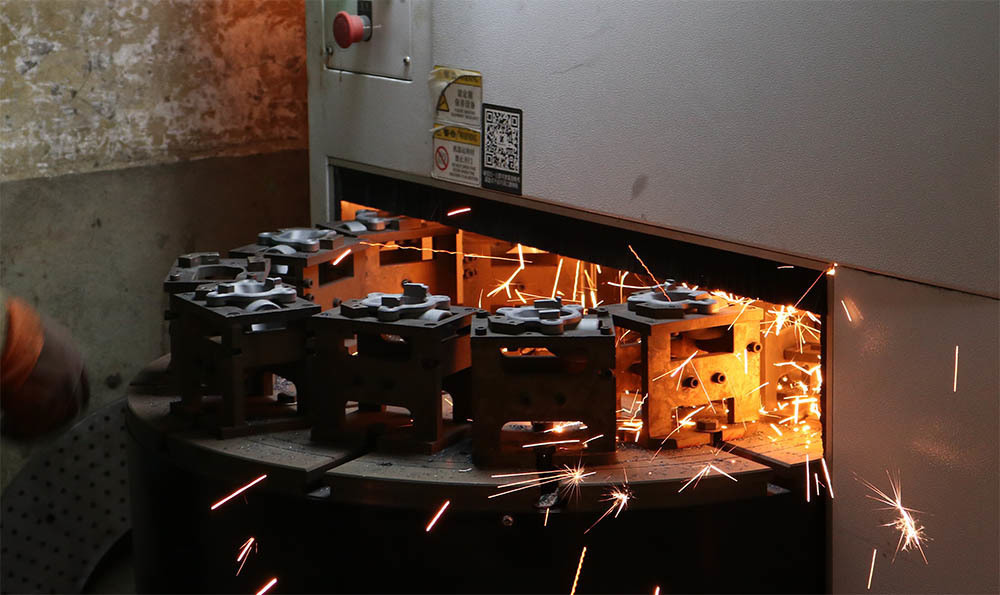
Since 2025, Tianye has invested in 2 smart die casting cells equipped with real-time melt temperature monitoring, pressure curve tracking and automated in-line inspection, which has reduced defect rates by 22% compared to legacy production lines. By 2027, we expect 80% of our automotive production lines to be connected to a centralized quality data platform that shares real-time production metrics with client quality teams on request.
Common Questions
Q: What is the typical lead time for China automotive parts die casting projects?
A: For standard aluminum alloy parts, sample lead time is 10-15 days after design confirmation, with mass production lead time of 25-35 days after tooling approval, depending on part complexity and required secondary operations.
Q: What material grades are most commonly used for automotive die casting?
A: The most widely used grades are ADC12 and A380 aluminum alloys for general structural parts, A356 for high-strength safety components, and ZA-3 zinc alloy for small, high-precision sensor housings and trim parts.
Q: Can Chinese die casting suppliers produce parts for North American and European automotive safety standards?
A: Yes, most qualified suppliers hold IATF 16949 certification, provide full batch traceability, and can meet material and performance requirements set by FMVSS, EU ECE and other global automotive regulatory frameworks.
Q: What is the minimum order quantity for precision automotive die cast parts from Chinese suppliers?
A: For most standard precision die casting projects, MOQ starts at 1000-5000 parts, with lower MOQ available for prototype development and small-batch niche automotive applications, depending on part complexity.
This article was generated by AI and is for reference only.
2024-01-20

2024-01-20
2188 Jiulong Avenue, Zhenhai, Ningbo, China
86-0574-86530988
sales@tianyecasting.com
