Home
About us
Products
Auto parts (gearbox)
Auto parts (exhaust systems)
Power tool parts
Power system parts
Stainless steel mountings/housings
Stainless steel valve/pipe parts
Other alloy castings
Power system parts (brass)
Copper alloy castings
Pure copper castings (high conductivity)
Copper alloy die castings
News
Contact
Language
中文简体
English
Джорджия
Español
Deutsch
日本語
Company news
Industry news
2024-10-17
Efficiency and Precision: The Future of Die Casting in Automotive Component Design
Efficiency and Precision: The Future of Die Casting in Automotive Component Design Table of Contents 1. Introduction to Die Casting in Automotive Manufacturing 2. Understanding the Die Casting Process 3. Advantages of Die Casting for Automotive Components 4. Key Applications of Die Casting in Automotive Design 4.1 Engine Components 4.2 Transmission Parts 4.3 Chassis and Structural Components 5. In
2024-10-16
Unlocking the Potential of Die Casting in Automotive Parts Manufacturing
Die casting is an essential manufacturing process widely utilized in the automotive industry for producing complex and high-precision parts. This method involves forcing molten metal into a mold cavity under high pressure, allowing for the creation of intricate designs that are often impossible to achieve with traditional manufacturing techniques. The automotive sector has embraced die casting due
2024-10-15
Sustainability Focus: Innovative Die Casting Solutions for the Automotive Sector
Sustainability Focus: Innovative Die Casting Solutions for the Automotive Sector Table of Contents Introduction: The Need for Sustainability in the Automotive Industry Understanding Die Casting: A Brief Overview The Role of Die Casting in Sustainable Manufacturing Eco-Friendly Materials in Die Casting Enhancing Energy Efficiency in Die Casting Processes Applications of Die
2024-10-14
Alloy precision casting
Another significant benefit of alloy precision casting is its versatility in accommodating different production volumes. It can effectively handle both low-volume and high-volume production runs, providing flexibility for manufacturers to respond to varying market demands without compromising quality or efficiency. Furthermore, advancements in technology, such as computer-aided design (CAD) and computer-aided manufacturing (CAM), have enhanced the precision casting process by enabling more accurate simulations, faster turnaround times, and improved defect detection.
Alloy precision casting is a superior manufacturing technique that involves creating highly accurate and complex metal parts from various types of alloys. This method combines the principles of metallurgy, engineering, and precise craftsmanship to produce components with exact dimensions, intricate details, and excellent surface finish.
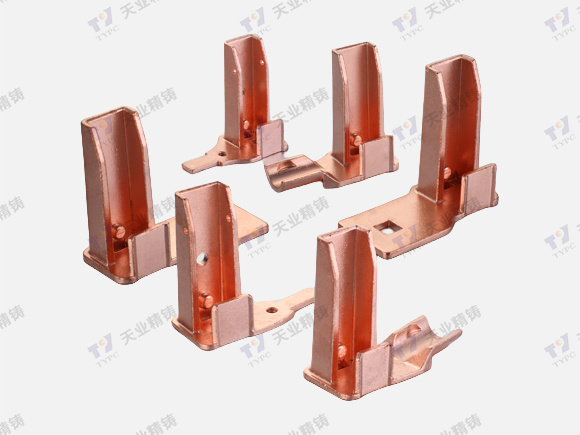
high conductivity Pure copper castings
In terms of manufacturing, high conductivity pure copper castings require specialized equipment and expertise. The process begins with the selection of high-purity copper, which is then melted down using a furnace or induction heater. Once the copper has reached the desired temperature, it is poured into a mold made from materials such as sand, ceramic, or graphite. The mold is designed to match the shape and size of the final product, and is typically coated with a refractory material to prevent sticking and ensure smooth surface finish.
High conductivity pure copper castings are a type of metal casting that is known for its excellent electrical and thermal conductivity. These castings are made from high-purity copper, which has been melted down and poured into molds to create a variety of shapes and sizes. The process of creating these castings involves several steps, including the preparation of the mold, the melting of the copper, and the pouring of the molten metal into the mold.
Copper alloy die castings are a versatile and high-performance category of materials widely used across various industries. These alloys are primarily composed of copper, which is known for its excellent thermal and electrical conductivity, corrosion resistance, and workability. By combining copper with other metals such as zinc, tin, aluminum, or nickel, manufacturers can tailor the properties of the alloy to meet specific application requirements.
Heat resistant steel casting
Heat resistant steel casting is a type of metal casting that is specifically designed to withstand high temperatures. It is made from heat-resistant alloys, which are composed of elements such as chromium, nickel, and molybdenum that provide excellent resistance to thermal stress and oxidation. These materials are ideal for applications where exposure to extreme heat is common, such as in the aerospace, automotive, power generation, and petrochemical industries.
alloy steel castings
Alloy steel castings are a diverse range of materials that find applications across various industries due to their superior mechanical properties and resistance to wear, heat, and corrosion. These castings are produced by introducing alloying elements such as chromium, nickel, molybdenum, vanadium, and manganese into steel during the manufacturing process. The addition of these elements refines the microstructure of the steel, thereby enhancing its overall performance and making it suitable for demanding engineering applications.